
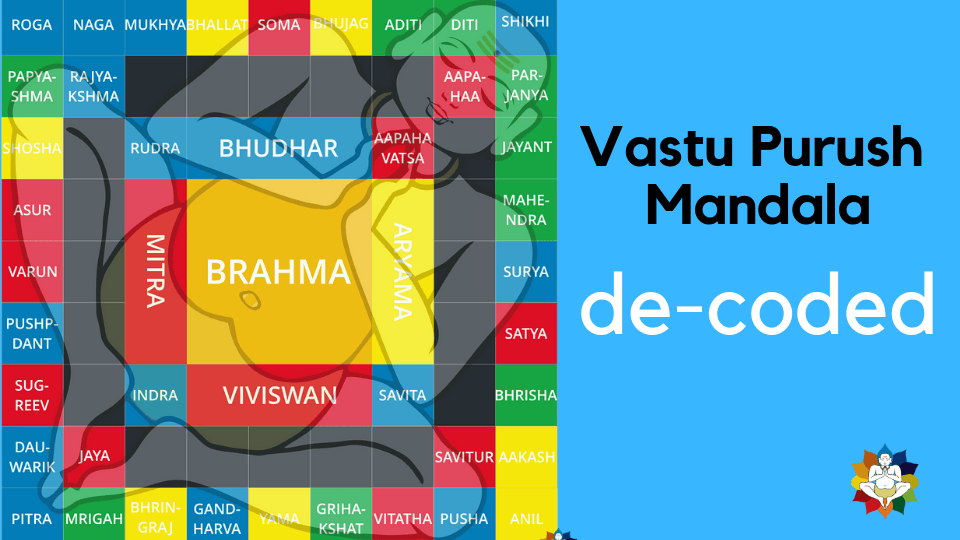
Vastu Purusha Mandala is the foundational energy grid in Vastu Shastra that divides a space into 45 cosmic zones used to design houses, temples, and cities for balanced energy flow.
The Vastu Mandal is the secret that contains the essence of the sacred science of Vastu in its entirety.
From time immemorial, this cosmic geometrical wonder has been used to design everything from the yagya vedis (fire altars), temples, entire villages, towns and individual houses.
What is Vastu Purusha Mandala?
Vastu Purusha Mandala is the fundamental energy grid used in Vastu Shastra to design houses, temples, cities, and structures based on the distribution of 45 cosmic energy fields (devtas).
- Represents the cosmic being (Vastu Purusha) spread across a geometric grid
- Forms the basis of all Vastu planning and architectural alignment
- Defines the placement of rooms, entrances, and functional zones
- Includes Brahmasthan (center), directional energies, and outer energy fields
In simple terms, the Vastu Purusha Mandala is the metaphysical blueprint of every building, guiding how universal energy flows through a space.
Every minute detail with regards to every single structure is based on these universal principles of the Vastu Purush Mandala architecture.
When we observe the energy fields that develop at different stages of a building – starting from the stage of a vacant plot to the digging of land to the laying of the foundation to the completion of the building and finally to the point when it is inhabited by the people – we unravel the secrets of the Vastu purusha mandala.
The Vastu Mandala is the omnipresent, omnipotent soul of every building. It is based on the principle that man and Universe are analogous in their structure and spirit. Vastu Purush Mandala is thus a Yantra or an image of the Universe.
The Yajurveda reveals –
यथा ब्रह्माण्डे तथा पिंडे II यथा पिंडे तथा ब्रह्माण्डे
II Yatha brahmande tatha pinde , Yatha pinde tatha brahmande II
As is the universe, so is the physical body. As is the physical body, so is the universe
Thus, the Vastu Purush Mandala represents the manifest form of the cosmic being. Whatever is in the universe is within us.

The belief that the earth is a living organism, throbbing with life and energy is fundamental to the Vastu Shastra.
The Vastu Purush Mandala symbolizes that living energy. The site for the construction is his field- the Vastu Purush Mandala.
The ‘Purusha’ here refers to the energy, power, soul or the cosmic man. Mandala is the generic name for any plan or chart which symbolically represents the cosmos.
Beginner Explanation: Understanding Vastu Purusha Mandala
If you are new to Vastu, think of the Vastu Purusha Mandala in three simple ways:
- An energy map – It shows how different energies are distributed across a plot or building.
- A planning grid – It helps decide where to place rooms like the kitchen, bedroom, and entrance.
- A cosmic floor plan – It connects the structure of a house with natural forces like the Sun, directions, and elements.
In simple terms, the Mandala is the foundation on which Vastu-based design is created. It guides how a space should be organised so that energy flows in a balanced and supportive way.
The Vastu Purush Mandala is the core of every structure.
You can use it to design a temple, a house, an office and even when you’re planning the Vastu of a factory or a whole city. It constitutes the geometrical and metaphysical basis for every construction.
Table Of Contents
- The Story of Origin of the Vastu Purusha Mandala
- Hidden Secrets in Symbols and the Mandala
- 45 Devtas of the Vastu Purusha Mandala
- Central Energy Field: Brahma (Brahmasthan)
- The 4 Energy Fields: Deva Vithi
- Diagonal Energy Fields: Manushya Vithi
- 32 Outer Energy Fields: Paishacha Vithi
- Marmasthan (Marma Points) in Vastu Mandala
- Installation of Vastu Purusha Mandala
- Myths vs Facts About Vastu Purusha Mandala
- FAQs
- Conclusion
The Story of Origin of the Vastu Purusha Mandala

The ancient Vastu text of Vishwakarma Prakash reveals an engaging story about the origin of the Vastu Purusha Mandala .The story is about a fierce war between the Gods (devtas ) and the demons (asuras). In this war, Lord Shiva represented the devtas while Andhaka asur was fighting for the asuras.
During the war, some drops of sweat fell on the earth. From those drops emerged a gigantic being that scared both the devtas and the asuras. The devtas and the asuras together took this being to lord Brahma. Lord Brahma called this giant his manas putra (mind-being) and named him Vastu Purush.
The Vastu Purush was then laid down on the earth prostrate with his head towards the North East and feet to the South West. Some of his parts were inhabited by the devtas while some by the asuras.
Lord Brahma then ordered that whoever reveres the Vastu Purush and perform the Vastu Purush pooja while constructing a temple, palace, house, pond, city etc. will be blessed by the devtas. The ones who don’t would be destroyed by the asuras.
Modern Interpretation: The Vastu Purusha Mandala can be understood as an energy zoning map used to plan a building. Each square represents a specific life function such as health, wealth, relationships, movement, or stability.
The central zone (Brahmasthan) acts as the core energy centre of the property, while the corners represent strong directional forces that influence different aspects of life.
When spaces are aligned according to this grid, the structure supports balance and harmony in daily living.
Hidden Secrets in Symbols and the Mandala
The above story is of course symbolic because in the Vedas, deep secrets have been woven into stories.
To unlock these secrets, the deeper meaning of these symbols and the Mandala has to be understood.
The Vastu Purush Mandala is not necessarily an actual picture of a giant encased in numerous cells or squares. It is a diagrammatic representation through symbols, of the inter-sections and the energy current flows in the subtle body of a human being.
The Purusha, in the Vastu Mandala chart is a term of reference.
It serves as a means to locate several parts, within the whole. The body here indicates a sphere of coordinated activities; and each part corresponds to a particular function.
The devtas represent our consciousness and the asuras our ignorance and fear. The war between consciousness and ignorance still goes on each moment within all of us. It is not just a Puranic story, it’s the reality we live in each moment.
The Vastu Purush represents the constant phenomenon inside each building.
The Purusha means that which is stable and contains all possibilities of existence within him.
The Vastu Purusha is the soul of the building. As soon as a building comes into existence, all the devtas and asuras occupy their respective positions.
As a result, they create the effects and results that the inhabitants experience through their lives while living in that building.
This above story is depicted diagrammatically in the Vastu Purush Mandal Chakra with specific portions allocated hierarchically to each deity based on their attributes and powers.
Why Vastu Purusha Mandala Matters in Modern House Planning
The Vastu Purusha Mandala is not just a symbolic diagram — it is the foundational planning grid used to design balanced and energy-aligned spaces. Even in modern homes, apartments, offices, and factories, this Mandala acts as the master blueprint that determines how different zones of a structure function.
Each section of the Mandala corresponds to specific energy fields that influence daily life. When used correctly, it helps create harmony between natural forces, built space, and human activity.
- Guides correct placement of rooms like kitchen, bedroom, and pooja area
- Defines the Brahmasthan (central energy core of the property)
- Helps identify strong and sensitive directional zones
- Influences entrance positioning and energy flow patterns
- Supports balance related to health, stability, and prosperity
In practical terms, the Vastu Purusha Mandala works as an energy zoning map that helps align construction with natural forces. This is why it has remained the basis of temple architecture, town planning, and residential design for thousands of years.
45 Devtas of the Vastu Purush Mandala- Attributes of Devtas as per Vastu Purush Mandal Chakra
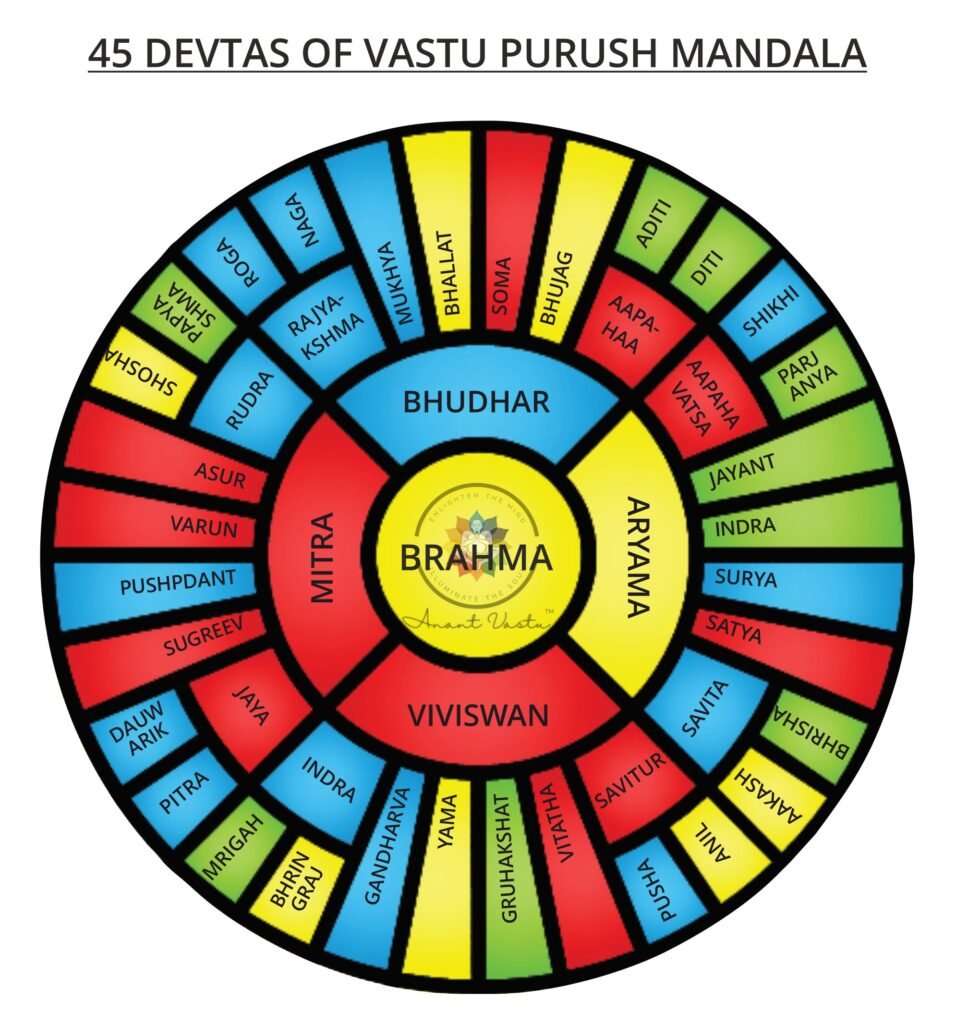
In total there are 45 Vastu Devtas that constitute the Vastu Purush Mandal chakra. The names and the attributes of these 45 energy fields of the Vastu Mandal are explained below.
The division of the built-up space represents different energy fields. We call this process – the Pada Vinyasa . The above image is a diagramatic representation of the Vastu Purush Mandal Chakra.
Complete List of 45 Vastu Devtas (Quick Reference Table)
This summary table provides a quick, structured overview of all 45 energy fields (devtas) present in the Vastu Purusha Mandala along with their primary role in influencing different aspects of life and space planning.
| Devta | Primary Role / Energy Function |
|---|---|
| Brahma | Central creative force; source of balance and life energy |
| Bhudhar | Supports manifestation and foundational strength |
| Aryama | Represents social connections and expansion |
| Vivaswaan | Energy of transformation and progression |
| Mitra | Inspiration, support, and growth |
| Apaha | Healing and purification energy |
| Apahavatsa | Strengthens recovery and health support |
| Savita | Initiation of actions and new beginnings |
| Savitur | Continuity, endurance, and momentum |
| Indra | Stability, authority, and growth |
| Indrajaya | Channels for success and achievement |
| Rudra | Support system and movement of life energy |
| Rajyakshma | Mental stability and emotional balance |
| Aditi | Security, protection, and nurturing energy |
| Diti | Vision, perception, and deep insight |
| Shikhi | Creative thinking and idea generation |
| Parjanya | Fertility, growth, and abundance |
| Brisha | Drive and friction required to initiate effort |
| Akash | Space for expansion and manifestation |
| Anila | Air element; movement and support to fire energy |
| Pusha | Nourishment, protection, and sustenance |
| Bhringraj | Health, digestion, and vitality |
| Mrigah | Curiosity, learning, and skill development |
| Pitra | Ancestor support and lineage strength |
| Dauwarik | Protection, knowledge, and guardianship |
| Shosha | Detoxification and emotional cleansing |
| Papyakshama | Karmic release and emotional burdens |
| Roga | Health challenges and resilience building |
| Naga | Desires, emotions, and sensual tendencies |
| Jayant | Victory, confidence, and mental freshness |
| Mahendra | Leadership and administrative ability |
| Surya | Health, vitality, and authority |
| Satya | Truth, reputation, and credibility |
| Vitatha | Illusion, confusion, and unreal perceptions |
| Gurhakshat | Mental discipline and focus |
| Yama | Law, control, and boundaries |
| Gandharva | Arts, creativity, and vitality |
| Sugreev | Knowledge reception and learning |
| Pushpadant | Desire fulfilment and blessings |
| Varun | Observation, depth, and universal control |
| Asur | Detachment and internal strength |
| Mukhya | Purpose, direction, and manifestation |
| Bhallat | Wealth expansion and result magnification |
| Soma | Money flow, nourishment, and prosperity |
| Bhujag | Healing, protection, and preservation |
These 45 Vastu Devtas and their attributes are as follows :
The Central Energy Field : Brahma , the Creator – Brahma Vithi
Lord Brahma occupies the central portion – the Brahmasthan. This portion is the Brahma Vithi. It is the most sacred part of the building. It contains within it, all the possibilities of creation and existence.
First the Shilanyas (foundation stone laying ceremony) is done and the construction of the foundation walls begins by digging the earth. When they reach the plinth level, the divine energy field called Brahma starts to originate right in the center of the plot.
This field of Brahma – the absolute is responsible for the evolution of everything in the universe. This is why the universe is also termed as Brahmaand (the golden egg of Brahma).
The 4 Energy Fields next to Brahma – The Deva Vithi
| Devta Name | Description |
|---|
| Bhudhar / Prithvidhar | He is the Anant Sheshnaag. The power of starting any process and leading to manifestation |
| Aryama | Sun or Aditya. The power of social connections. It carriers forward the process of evolution. |
| Vivaswaan | The power of transformation and progression. This energy is responsible for revolution or change |
| Mitra | The power of inspiration and action. This energy provides support and leads to expansion. |
As the construction of the building progresses and the raising of the walls is done to a height of about 5-8 feet , the energy field of Brahma starts to expand in 4 directions.
Out of the 12 Adityas mentioned in the Bhagavata Puran , the above 4 occupy the 4 sides of Brahma.
We all know that Lord Brahma has 4 heads. Thus these 4 devtas are symbolic of the 4 heads of Brahma. They are responsible for carrying forward the process of creation initiated by Brahma.
The 8 Energy Fields in the diagonal directions – The Manushya Vithi
After the raising of the walls ( but the casting of the roof is remaining) , the energy fields start to spread in the four diagonal directions viz. North East, South East, South West and North West.
This flow of energies is akin to a tortoise spreading its legs and extending them out of its body.
In each of these directions, two energy fields start to take shape and form. If we draw a line dividing the North East to South West and from North West to South East, one energy fields develops on either side of this dividing line.
The North East direction represents the head and the South West direction represents the legs / lower half of the Vastu Purush.
The names of these energies are as follows :
NORTH EAST
- Apaha ( generates the energies responsible for healing)
- Apahavatsa (carriers the healing powers to the occupants)
SOUTH EAST
- Savita (energies that help to initiate any process or action)
- Savitur (energies that give capibilities to continue those actions and overcome all challenges)
SOUTH WEST
- Indra (energies that establish stability and enhance growth)
- Indrajaya (the tools and the channels through which one can achieve growth)
NORTH WEST
- Rudra (energies responsible for support and ensure flow of activities and life)
- Rajyakshma ( energies which uphold the support and stabilise the mind)
The 32 energy fields of the outer periphery – Paishacha Vithi
A total of 32 energy fields develop in a concentric pattern in the outer periphery of the Vastu Purusha Mandala. These energy fields represent the 32 possible Main Doors Entrances as per Vastu.
Once the roof is cast in the building, four energy fields start to develop in each of the diagonal directions. Thus, a total of 16 fields develop in the diagonal directions which are as follows:
NORTH EAST
- Aditi (the mother of the devtas, this energy field provides security and helps one connect with himself/herself)
- Diti (the mother od the asuras, this energy field gives the powers of a wider vision and to see the actual truth of life)
- Shikhi (symbolic of a pointed flame. This field gives the power of ideas and the ability to project one’s thoughts to the world )
- Parjanya (the giver of rains, this field has the powers to bless the occupants with fertility and fructification of all their wishes)
SOUTH EAST
- Brisha (the power of friction needed to initiate any action , thinking or activity)
- Akash ( the energy that provides the space for manifestation)
- Anila ( the energy of air or vayu, it helps to uplift the fire or push further the actions initiated)
- Pusha ( the energy of nourishment, it blocks the path of enemies)
SOUTH WEST
- Bhringraj (the energy which extracts nutrients from the food and removes the waste)
- Mrigah (the energy that drives curiosity and imparts skills)
- Pitra ( the ancestors provide all means of safety and happiness required for existence)
- Dauwarik (the safekeeper, represents lord Nandi, the trusted vehicle of lord Shiva. The energy of being genius and highly knowledgeable)
NORTH WEST
- Shosha (the power of detoxification from negative emotions)
- Papyakshama (the energy which gives addiction, diseases and the feeling of guilt)
- Roga ( the energy which provides support in the hour of need)
- Naga ( the energy which gives emotional enjoyments and cravings)
Once the super-structure, i.e. the civil work is done but the installation of services like plumbing, electrical connections etc. has not begun , 16 more energy fields start to develop in the four cardinal directions. These are as follows :
EAST
- Jayant (the energy which gives the sense of being victorious, it refreshes the mind and body)
- Mahendra ( the power of administration and connectivity )
- Surya ( the core controller, this energy fields imparts health , fame and farsightedness)
- Satya ( the energy which establishes goodwill, status, authenticity and credibility)
SOUTH
- Vitatha ( the energy field of falsehood, pretension and the unreal)
- Gurhakshat ( the power which binds the mind and defines its limits. Best location for a main door in a South Facing House as per Vastu .)
- Yama ( the power of expansion, this energy field binds the world in laws)
- Gandharva ( the energy of preservation of health and vitality, this is also the energy which governs all kinds of arts and music)
WEST
- Sugreev ( the power which grants the ability to receive all knowledge)
- Pushpadant ( the power which grants blessings and fulfils all desires )
- Varun ( the lord of the seas, this energy field observes and runs the whole world. It is the granter of immortality)
- Asur ( the energy field that releases the mind from temptations and gives depth in spirituality )
NORTH
- Mukhya ( the chief architect or lord Vishwakarma, this energy field defines the main purpose of the building and also helps in their manifestation)
- Bhallat ( the energy field which grants colossal abundance, it magnifies the efforts and their results )
- Soma (the energy field of lord Kuber, the lord of all wealth and money. It ensures a smooth flow of money and opportunities)
- Bhujag ( the lord of hidden treasures, this energy field is the preserver of medicines. It safeguards the health of the occupants )
Marmasthan (Marma points) in Vastu Purush Mandala
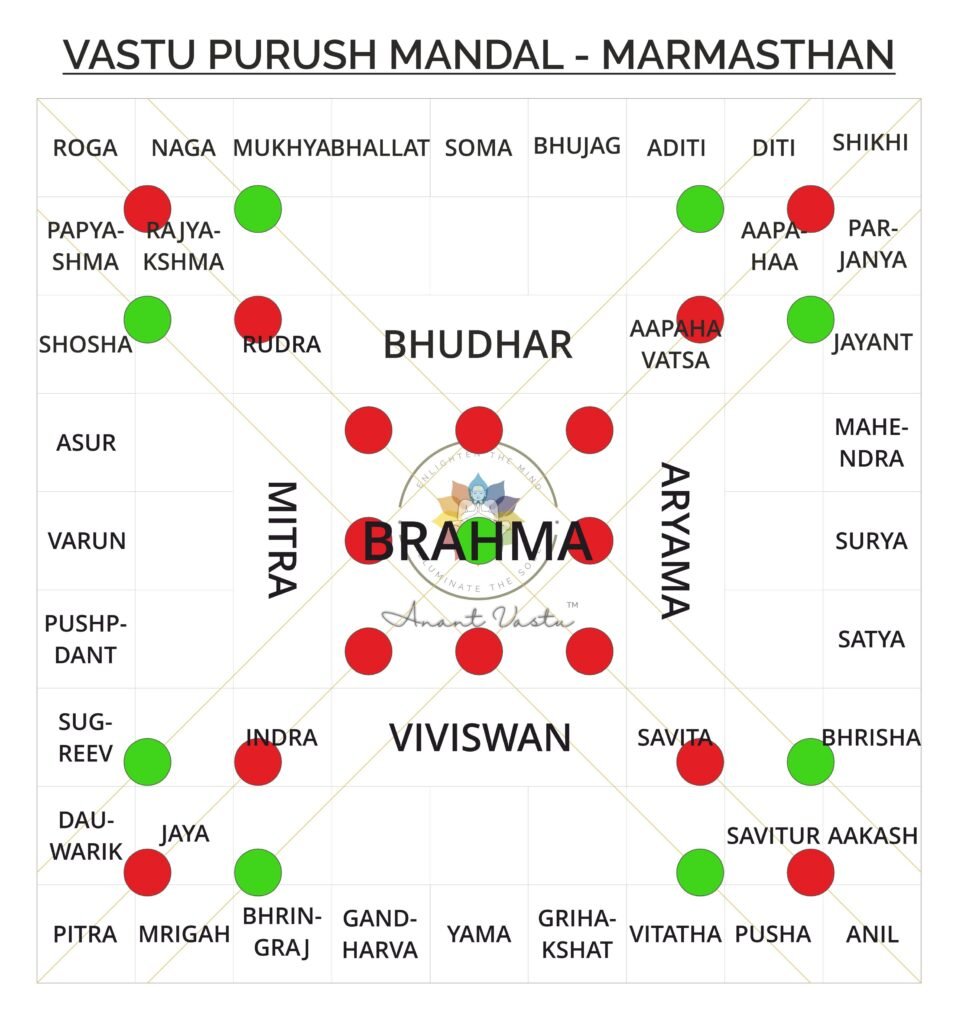
While a Vastu architect meticulously plans the layout, there’s a hidden blueprint you must honor—the Marmasthanas in Vastu Purush Mandala.
When designing a property, it’s not just about aesthetics or functionality—there’s a deeper layer of energy at play.These Marmasthaans are vital energy points that must be dealt with extreme caution.
These extremely powerful but sensitive energy points in the Vastu Purusha Mandala are key to creating a space that feels truly alive and harmonious. You can safely assume that your property’s energy flow can hinge on these very critical points.
In Vastu Shastra, Maha Marmas are the cosmic energy coordinates we should never disturb. These powerful nodes are sacred intersections where energy lines converge, much like the veins of a living body carrying Prana. According to the ancient text Brihat Samhita, there are nine Maha Marmasthanas, calculated at the intersections of six diagonals within the Mandala (as shown in the diagram above).
In revered works like Vastu Soukhyam and Samrangangan Sutradhara, these diagonals are called Vanshas and extend between specific energy cells from:
- Shikhi to Pitra
- Aditi to Sugriv
- Jayant to Bhringraj
- Roga to Anil
- Mukhya to Bhrisha
- Shosha to Vitatha
The Maha Marma points mark where these lines intersect, representing the head, mouth, heart, navel, anus, and nipples of the Vastu Purusha. Just as in the human body, one should never harm these sensitive points. The horizontal, vertical, and diagonal lines within the Mandala act as the veins of the Vastu Purusha, channeling life-giving cosmic energy and transforming your plot into a living entity.
Why Does It Matter?
Disturbing these energy points—through pillars, nails, heavy structures, or even poorly placed doors and windows—can cause significant energy imbalances. Such disturbances, referred to as Marma Vastu Vedha, can lead to severe Vastu defects, impacting the harmony and prosperity of the property.
Treat your property like a living being. Respect the Marmasthanas, and you’ll unlock a space that not only supports but also amplifies your well-being, success, and peace.
Installation of the Vastu Purusha Mandala – Vastu Purusha Sthapana
A few common questions which we come across are:
- How should we do the Vastu Mandala sthapana or where to bury Vastu Purush or Vastu yantra?
- What are the ideal directions to put Vastu Purush in the house or the best Vastu Purusha location in the house?
- Should we put it on the floor or bury underground?
This is what we believe :
There is absolutely no need to put any Vastu Purush structure in your house. Neither an idol on the ground nor any Vastu Purusha Yantra underground.
The Vastu Purush is a metaphysical being. It is a diagrammatic and geometric representation of the whole universe.
In other words, it is a combination of 45 different energy fields that exist within every built-up structure. It’s there in a 100 sq.ft. Office and it’s there in a 50,000 sq.ft. Factory.
Whether or not you place an idol or yantra, these energy fields (together called the Vastu Purush Mandala) will exist in different proportions in your building.
Therefore, all you need to do to please the Vastu Purusha is to design your house as per the tenets of Vastu Shastra, keeping in mind the Vastu Purusha Mandala. This is the biggest offering you can make to the Vastu Purusha. Above all, this is the greatest favour you can do to yourself and your family.
Myths vs Facts About Vastu Purusha Mandala
This quick comparison clears common misunderstandings about the Vastu Purusha Mandala and explains what it truly represents in practical Vastu planning.
| Common Myth | Actual Fact |
|---|---|
| Vastu Purusha Mandala is just a religious symbol | It is a spatial energy grid used for architectural planning and directional alignment |
| You must place a Vastu Purusha idol or yantra in the house | The Mandala exists naturally in every structure; correct planning is more important than placing objects |
| It only applies to temples and ancient buildings | It is used in designing modern homes, flats, offices, factories, and cities |
| It is based only on mythology | The symbolic stories represent energy zones, spatial balance, and natural force alignment |
| Only the centre (Brahmasthan) matters | All 45 energy fields influence different aspects of life and space planning |
| The Mandala is the same as a floor plan | It is an energy map that guides how a floor plan should be created |
| Ignoring it causes instant bad results | It affects long-term balance, movement, health, and stability when used correctly |
| It is only relevant during construction | It influences planning, room placement, entrances, and energy flow throughout the building’s life |
About the Author
This guide is written by Abhishek Khandelwal, a professional Vastu & Astro-Vastu consultant with over 19+ years of field experience working with residential homes, commercial properties, factories, and land energy corrections across India and internationally.
real site audits, compass-based measurements, directional energy mapping, and practical planning observations — not just theoretical concepts or copied interpretations.
Planning a home, buying a plot, or designing a new space? Get a precise Vastu analysis based on your exact layout and directional alignment.
Book Your Vastu Consultation →
Living in a different city or outside India?
Explore Online Consultation Options
Based on actual site experience and Astro-Vastu analysis — not generic remedies.
FAQs for Vastu Purusha Mandala
Which is the best place in the house for Vastu Purusha Mandala?
The Vastu Purusha Mandala is not something that needs to be physically placed in a house. It already exists as an energy grid within every structure. If a Vastu Yantra is used, it is usually kept in the pooja room for symbolic alignment.
What is the head direction of Vastu Purusha?
In the Vastu Purusha Mandala, the head of Vastu Purusha is believed to lie in the North-East direction, while the feet extend towards the South-West. This orientation forms the basis of directional energy interpretation in Vastu planning.
What is Vastu Purusha Mandala?
Vastu Purusha Mandala is the fundamental planning grid in Vastu Shastra. It represents a geometric energy map divided into multiple zones, each governed by specific cosmic energies that guide the placement of rooms, entrances, and functional spaces in a building.
How many divisions (padas) are there in Vastu Purusha Mandala?
There are multiple types of Vastu Purusha Mandalas. The most commonly used grids contain 64 padas (8×8) and 81 padas (9×9), which divide the space into structured energy zones for architectural planning.
Is it necessary to install a Vastu Purusha Yantra in the house?
No. The Vastu Purusha Mandala is an inherent energy structure present in every building. Installing a yantra is optional and symbolic, not mandatory for Vastu alignment.
Why is Vastu Purusha Mandala important in house planning?
It acts as the base layout for Vastu design. The Mandala helps determine the correct placement of rooms, entrances, and open spaces so that natural energies flow in a balanced and supportive manner.
Conclusion
This is how the 45 energy fields develop and progress as per the Vastu Purush Mandala. These Vastu Mandala devtas and asuras manifest and move life and contribute to everything that happens in the lives of the occupants.
“The Vastu Purusha Mandala represents the manifest form of the Cosmic Being; upon which the temple is built and in whom the temple rests. The temple is situated in Him, comes from Him, and is a manifestation of Him. The Vastu Purusha Mandala is both the body of the Cosmic Being and a bodily device by which those who have the requisite knowledge attain the best results in temple building.” – Stella Kramrisch ; The Hindu Temple, Vol. I
We can replace the word temple above with any built up structure like a house, factory, office etc. Every constructed structure is really the manifest form of the cosmic being.
The universal equation of the Vastu Purush Mandala has been in existence for thousands of years and will continue till eternity. It is the fundamental principle which will continue to create and run the whole universe both at the macro and the micro level.
Thus, it is advisable to keep the eternal rules of the Vastu Purush Mandala in mind while designing any structure. This will certainly ensure peace, health and prosperity.



Hi,
Where is the Brahma (center) of purusha mandala in a apartment building, which has 4 or more flats on each floor?
The entrance to each flat is not necessarily the cardinal direction for the entire building; so how do you determine the energy fields
Hello!
I did not understand your question clearly. Though will try to answer based on whatever I have understood.
Firstly, we have to calculate the Brahmasthan (centre) of the plot, of the entire floor (including all flats) and of each flat separately. To calculate the Brahmasthan of an apartment building, you have to consider the entire floor area including all the flats. If you’re not a builder (and have no control over the entire building/plot area) and only a flat owner, you should only be concerned about calculating the centre of your flat.
To calculate the Brahmasthan of a particular flat, you only have to consider the net usable area of that particular flat. And there is no link between the Brahmasthan and the cardinal directions. The centre of a flat/ floor will be calculated irrespective of the cardinal directions to determine the energy fields present there.
Generally, the Brahmasthan area would be Length divided by 3 and Breadth divided by 3.
So if we assume the total flat area is 45 ft. X 30 ft., the Brahmasthan would be around 15 ft X 10 ft of area in the center.
Hope that answers your question. Do feel free to write to us in case of any further queries.
Dear Abhishek ji
As we know apartments have uneven floor plans. Sometime north-west corner is missing and other time some other. So how do we calculate Brahmsthan in such situations. I am attaching a layout. Please advise.
Dear Prakash Ji,
we use a mathematical formula to find out the center of gravity of such uneven floor plans. That’s the only way one can know where the Brahmasthan lies in odd shaped structures. In your case, since the flat is odd shaped, that’s the ideal way to find out the center.
For a basic calculation, you can simply draw a rectangle around the floor area and find out the approximate center by drawing two intersecting lines. However, to be precise, you need to use the center of gravity formula.
Abhishekji,
Thank you for your answer, my question is also about direction of energies emanating from Brahma. In your article, you mentioned energies moves along diagonals. Since the Brahmastaan of plot is in center, a flat that is entirely in the North East corner of lot will only have Apaha/ Apahavatsa energies and no other energies will be flowing into the unit.
If that is the case, even if the main door entry of that NE corner flat is on the south wall of that flat, yet it is not actually the south side of the entire plot. What does Vastu Shastra say about this.
There is an analogy with huge bungalows and palaces built with multiple rooms, which have only one brahmastaan. So why should a building/plot have many brahmastaan within each flat.
Sunil Ji,
that’s an interesting question you have asked.
Actually, while determining the energy fields within your flat, the net usable area which you own will be taken in to consideration. Using your analogy of palaces, the entire palace was owned by a particular king. So a separate Vastu was applicable for that king and his specific palace. And there could be different palaces within a kingdom owned by different kings or his subordinates. Thus, the calculations would be done individually for different palaces separately and for the whole kingdom area as a separate entity.
In earlier times, as per the texts of Vastu Shastra, different people were given different parts of a village to live in. The Brahmins were given the Eastern part of a village, the Kshatriyas were given the Southern part and so on. So logically, they were supposed to be living in a particular energy field that would best suit them when you consider the village as a whole.
In addition to that, their individual houses were then constructed according to a a different Vastu mandala. Even the wells in the village had a separate Vastu Mandala plan.
So your net usable area is an important consideration while determining the energy fields of the Vastu Purush Mandala. Your flat’s energy fields will effect you more than the fields of the entire plot because of its divided ownership.
Can a study table be placed in Mitra area facing east??
Is it correct as per vastu???
I am daughter of house and so i have been given North west room. I have my study table in North west direction at present. But i feel very unstable while studying here and thus i end up studying very less.
Space outside my room is open and i guess its mitra and brahma area……….so will it be good if I place my study table In Mitra are facing east????
Yes, it’s perfectly fine to place your study table in the energy field of Mitra. In fact, if you look at the Vastu Purusha Mandala, you’ll find the energy field of Sugreev as an extension of Mitra. This is considered to be the best place for a study table. The power of Sugreev helps you grasp a subject very well and more importantly retain the knowledge.
So if possible, try placing the table in the area of Sugreev and see the magic.
Can you let me know 8 vasu 12 Aditya 11 Rudra in vastu purush =33 and Asura Differently.
The 12 Adityas are the 4 main energy fields next to Brahma :
Bhudhar
Aryama
Vivasvan
Mitra
and the 4 pairs of energy fields in the 4 diagonal directions :
Apaha-Apahavatasa
Savita-Savitur
Indra-Indrajaya
Rudra-Rajyakshma
There is no exact clarity or definition of the Vasus in the Vastu Purush Mandala. There are different versions in the Skand Purana, Bhagavat Puran and Vishnu Purana. As per some texts, the 8 Vasus are the energy fields in the East other than the Adityas. While some texts mention the 8 Vasus as :
The 5 elements ( Earth,Fire,Water,Air & Space) + The Sun + The Moon + The Nakshatras.
Even the names of the Adityas differ in different texts.
In simple terms, the different energy fields are a symbolic representation of the Devtas & Asuras and that’s how they show their effects in a built up space.
Sir, What about those plots which are not rectangular or square in shape. e.g mine is kind of in a T-shape and has quite less space in the mid portion that connects the two rooms, so the whole bramhasthan would occupy that place and there would be possibly no space alloted for any of the devatas in the north and further subdivisions.
My question is are those devatas cut/ or not present like sometimes it happens with directions in certain plots? Also what to do in such a case.
Yes a cut in any direction is not good. It’s like not having a particular part of the body. That’s why in Vastu, T- shaped plots are not recommended.
In the modern context, we have devised certain ways to treat those cut areas.
The most amazing article on the internet. I have never found such vast and in-depth information on Vastu Purush Mandal anywhere. Keep up the great work
Thank you. We’re glad you found the article helpful.
Abhishek sir thank you for sharing this
Knowledge.
I want to know how to calculate aap and aapvatsa area and som also thanks in advance…
Thanks for the appreciation. It’s difficult to explain the entire process of calculating Apaha , Apahavatsa or any other energy fields here. It’s a detailed process and thus needs time to understand or explain.
However, a simple way which can help you identify these 2 fields is to draw a pie starting from the central fields of Brahma and extend it upto North and North East. The middle area in this pie will be the fields you’re looking for.
Abhishek ji, First of all Thanks for sharing̱ this wonderful information. I have read many websites and mostly found the same content is written in other words. Your understanding for Vastu is very impressive, vast & indepth.
My ques. is
1. Does it is necessary to built house structure in square or rectangular form only or else it is related to the size of plot owned only?
2. If a corner plots, i.e. the plot having roads in 2 sides has cutting of plot from corner such that the sharp corner is converted to the round curve in view of the road turning then does this plot has vastu defect?
Thanks for your comments Himanshu ji !
Here are the answers to your questions:
1. A square or a rectangular shape is ideal for a house. Any odd shape is ideally not recommended . However, the extent of cuts or extensions in a plot due to the shape will actually decide whether the plot is suitable or not.
2. The extent of the cut or curve will decide how big a Vastu defect it is. Also the direction in which the curve exists can play an important role.
Hello, May be late to reach this tremendous treasury of knowledge you have. I can read importance of Vivaswan Field as extension of Brahma. I am trying to plan a house with plinth 5 feet above natural ground. If we put up a small mechanical elevator for elders (that means a square pit of 4 feet depth will be dug below floor level of house) will it be allowed in Vivaswan area field? Or I mean, can such a pit below elevator cabin is allowed in Vivaswan field? Thanks
It really depends on where the pit is . Vivaswan is a big energy fields so need to analyze before commenting.
Namasthey Sir,
I am constructing an individual house in my own plot.
In my plot’s center brahma marmasthan, there are no pillars or beams, however in my floors brahma marmasthan a pillar and beam is coming.
Please advise if it is an issue and how to remediate this.
Namaste ! It is advisable to consult an expert. It’s difficult to say without checking the drawing. A pillar in the Marma sthaan is not a good thing. It can cause problems in the future.