

An East-facing house as per Vastu, is defined by the direction of its main entrance, measured from the geometric center of the structure. It is considered auspicious only when the entrance falls within the true East zone (approximately 80°- 100°) and the Eastern sector remains free from toilets or heavy obstructions.
Most people believe an East-facing house is a shortcut to prosperity. However, 19 years of auditing has shown me that without precise degree alignment, that ‘shortcut’ often leads to professional stagnation.
To understand how all directions function within a house — including their zones, energy roles, and impact — refer to the complete Vastu directions guide.
Methodology Used in This Guide:
Every conclusion in this article is based on a fixed 5-step residential Vastu audit framework that we apply consistently across all site inspections—irrespective of city, plot size, apartment, or villa type.
This framework is part of our comprehensive Vastu for Home audit which explains how facing direction, room placement, entrances, and elemental balance work together in any residential property.
The framework evaluates entrance degree accuracy, internal energy flow, room-to-direction alignment, Panch Tattva balance, and non-demolition correction feasibility. No observation here is based on belief, internet rules, or symbolic assumptions.
Is an East-facing house good or bad as per Vastu?
Answer: An East-facing house is good only when the main door lies within the Jayant or Indra padas of the true East zone and the Eastern sector is free from toilets or heavy obstructions. If the entrance shifts toward ESE or the East is structurally imbalanced, the same house causes anxiety, reputation loss, and financial instability.
About the Author: This guide is written by Abhishek Khandelwal, a professional Vastu & Astro-Vastu consultant with over 19+ years of field experience auditing flats, villas, independent houses, and high-value residences across India and internationally.
Everything explained here is based on real site inspections, compass measurements, and post-correction results—not textbook theory or internet remedies.
Table of Contents
- What Exactly Is an East-Facing House?
- Why Does an East-Facing House Matter So Much?
- How Does an East-Facing House Actually Work?
- Quick Summary: Instant Verdict
- When an East-Facing House Works (and When It Doesn’t)
- Step 1: Degree Accuracy & the 23.5° Illusion
- Step 2: Main Door Vastu – The 32-Pada Audit
- Step 3: Energy Flow Inside the House
- Step 4: East Facing House Vastu Plan (Kitchen, Bedroom, Toilet,)
- Staircase Vastu for East-Facing House
- Pooja Room Vastu for East-Facing House
- Step 5: Non-Demolition Corrections & Elemental Balancing
- Who Should (and Should Not) Choose an East-Facing House?
- East-Facing House as per Astrology – Is It Really Suitable for Everyone?
- Frequently Asked Questions (FAQs)
What Exactly Is an East-Facing House?
An East-facing house is defined only by the direction of the main entrance, measured from the geometric center of the building using a compass.
It is not decided by:
- Where you see the sunrise
- Balcony direction
- Road position
- Plot shape
These assumptions are the biggest reason people misjudge their house facing.
In Vastu, the East is linked to the Sun and is associated with:
- Authority
- Visibility and reputation
- Physical vitality
- Leadership and confidence
Because of this, the East is not a “neutral” direction.
It acts as the entry point for energy, influencing both how the house functions internally and how the residents are perceived outside.
Why Does an East-Facing House Matter So Much?
Many buyers assume an East-facing house is automatically a “gold mine”, especially in Indian real estate conversations because it faces the rising Sun.
In real-world audits and our professional casework at Anant Vastu, this assumption has proven to be one of the most damaging myths in residential Vastu.
The truth is simple:
East-facing houses fail just as often as they succeed—sometimes more severely.
Across years of audits, we have documented cases where residents lived in “perfect” East-facing properties yet they experienced:
- Chronic professional stagnation
- Unexplained anxiety and mental pressure
- Repeated conflicts with authority figures
- Financial leakage despite stable income
An East-facing house is not a guarantee of success. Its performance depends on entrance degree, Pancha Tattva balance, and internal zoning—not on direction alone.
How Does an East-Facing House Actually Work?
(The Solar Energy Gateway Concept)
Core Principle: An East-facing house functions as a solar energy intake system, not a luck enhancer.
The East governs how energy, visibility, and authority enter the house. If this intake is clean and correctly routed, it supports growth.
If it is distorted, the same energy creates pressure instead of progress.
The Correct Energy Flow:
- Energy enters from the East
- Moves freely through the Brahmasthan (center)
- Stabilises and grounds toward the West
When this flow is intact, residents experience clarity, confidence, and recognition.
When it is blocked or misaligned, results reverse silently.
Observed Benefits of Proper Flow:
- Improved public image and authority
- Clear decision-making
- Stable health and recovery
Observed Symptoms of Disturbed Flow:
- Restlessness and anxiety
- Ego clashes and internal friction
- Effort without proportional results
From professional audits, facing direction alone explains only 25–30% of outcomes.The remaining impact comes from degree accuracy, room placement, and energy routing.
Even a few degrees of error can convert supportive solar energy into a structural block that residents feel but cannot logically explain.
Quick Summary (Instant Verdict)
- Facing Definition: 80°–100° measured from the geometric center using a compass.
- Best Entrance Zones: Jayant (growth, victory) and Indra (authority, leadership).
- Worst Entrance Zone: ESE (mental churn, financial instability).
- Critical Dosha: Toilets or septic tanks in the East cause loss of recognition.
- Primary Benefit: Social status, authority, visibility, and career growth.
When an East-Facing House Works (and When It Doesn’t)
Simple Outcome Table
| Condition | Outcome |
|---|---|
| Entrance in Jayant or Indra + open East | Career growth, authority, recognition |
| Entrance in ESE or toilet in East, blocked East zone | Anxiety, financial churn, loss of respect |
Key Takeaway: An East facing house is conditionally auspicious. Unlike other directions, the East is governed by the Sun (Surya)—the source of life, authority, and social illumination. Because of this, an East-facing house behaves like a magnifying lens. It does not create results on its own; it amplifies whatever structural truth already exists in the house.
When an East-Facing House Works Exceptionally Well
1. Career Momentum & Authority: When the entrance is correctly positioned, these houses generate Indra Shakti—the energy of leadership. Residents often experience faster promotions and smoother dealings with government hierarchies. It is the direction of “Kings” and “Administrators.”
2. Health, Vitality & Recovery: An unobstructed East allows Ushakala (early morning solar rays rich in UV-B) to regulate circadian rhythm, serotonin levels, and vitamin-D synthesis. People recovering from chronic illness often heal much faster in properly aligned East-facing homes.
3. Social Visibility & Influence: This direction strongly supports professions that depend on “being seen”: sales, politics, business leadership, consulting, content creation, and teaching. When aligned, your work is not just done; it is acknowledged and remembered.
When an East-Facing House Becomes Harmful
1. The Anxiety Trap (ESE Rotation): If the house rotates toward East-South-East, the energy shifts from clarity to Manthan—constant churning. Residents remain busy but unproductive, planning yet rarely executing, leading to mental fatigue and burnout.
2. The Financial Leak (East Toilets): Toilets in the East symbolically and structurally flush away social credibility. Residents often report that despite working harder, their recognition goes to peers, or their reputation is unfairly tarnished.
3. Misplaced Fire Activities: Fire activities (kitchen or main electrical panels) in the East create ego clashes and power struggles inside the family—especially between father figures and senior members.
Step 1: The 23.5° Illusion – Why “Sun-Facing” Is Not Enough
Audit Method Used: Facing is measured using a magnetic compass from the geometric center of the house, not from balconies, gates, or road alignment. This method is used consistently across all professional audits referenced in this guide.
The single biggest reason East-facing remedies fail is misdiagnosis. Most homeowners assume their house is East-facing simply because they see the sunrise from a balcony or the main door. In structural Vastu, this assumption is scientifically flawed.
The Scientific Reality of Facing
Because the Earth tilts at 23.5 degrees, the Sun rises in the exact East (90°) only twice a year—during the equinoxes. On all other days, the sunrise drifts either northward (Uttarayana) or southward (Dakshinayana).
| Observed Sunrise | Actual Vastu Direction | Primary Impact on Residents |
|---|---|---|
| Slightly left of center | ENE (East-North-East) | Focus on Mental clarity & Refreshment |
| Exact center | True East (90°) | Focus on Social Standing & Recognition |
| Slightly right of center | ESE (East-South-East) | Focus on Anxiety & Financial Churn |
Anant Vastu Professional Case Study: We once audited a prominent businessman in a “perfect East-facing villa” who faced sudden, unexplained bankruptcy. Compass readings revealed a 115° ESE rotation. The owner had been using blue (Water) decor thinking it was the East. In reality, Water placed in the Fire-dominated South-East (115°) was “drowning” his financial liquidity. Result: A few degrees error caused a multi-million dollar crisis.
Common Mistakes in East Facing Houses
- Assuming sunrise view means true East
- Placing toilets or septic tanks in the East or North-East
- Using grey or black colors assuming “East = water”
- Heavy construction or staircases in the Eastern belt
- Main door positioned too close to ESE
Facing direction alone is not enough. Each direction behaves differently when misaligned.
For comparison, you can explore how a North facing house performs under Vastu, how structural errors affect a South facing house,
and why outcomes differ in a West facing house setup.
Step 2: Main Door Vastu – The 32-Pada Audit
In our Vastu analysis, the entrance is like the “mouth” of the house—it decides the quality of the life force (Prana) that enters your space. The Eastern zone is divided into 8 major divisions, further refined into 32 energy padas. Only two deliver the positive energies residents seek.
If you want a deeper breakdown of entrance padas, door directions, and common mistakes, read our detailed guide on Main Door Vastu for Houses, which covers all 32 entrances with corrective logic.
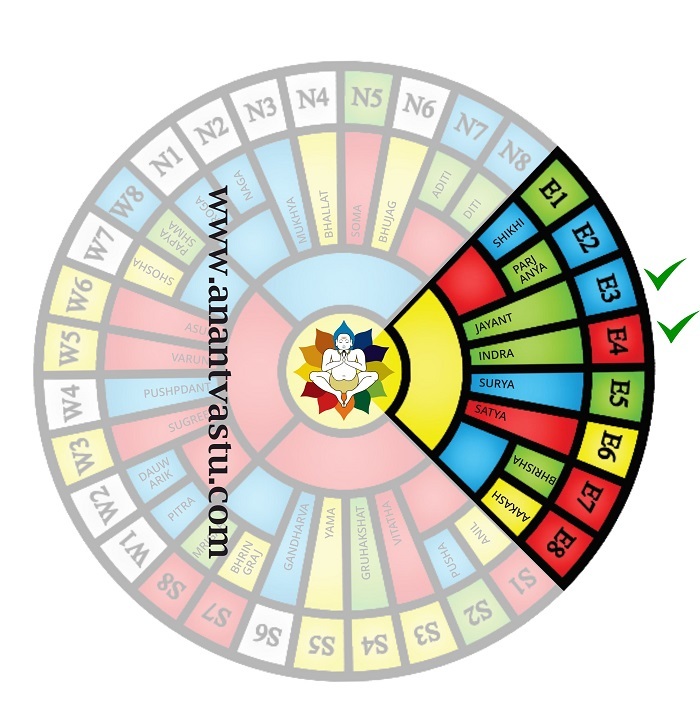
The Power Zones (Auspicious)
1. Jayant (3rd Pada): Located toward the North-East side of the Eastern belt. This pada enhances enthusiasm, learning ability, and children’s growth. It supports ethical success and long-term stability.
2. Indra (4th Pada): Located at the center-East. This is the zone of governance, authority, and leadership. It is the ideal entrance for business owners, CEOs, and administrators dealing with large systems.
The Danger Zones (Inauspicious)
1. ESE (6th & 7th Padas): Known as Satya & Bhrisha padas. These padas create extreme mental churn, impulsive decisions, and unstable finances. Residents often feel they are “one decision away” from success but never arrive.
2. NE Corner (1st & 2nd Padas): Known as Shikhi & Parjanya padas. While spiritually sensitive, an entrance exactly on the NE corner creates fire accidents and excessive expenditures. It also results in emotional volatility, health instability, or sudden “highs and lows” in career.
3. The Surya Pada (5th Pada): This is a mixed-impact zone. While it can grant power and recognition,it often comes with excessive ego, anger, or dominance—similar to an imbalanced Sun in a birth chart.
Step 3: Energy Flow Inside the House
Structurally, the East is the solar energy gateway of the house. Just like the respiratory system in the human body, if the intake is obstructed or polluted, the entire system’s vitality collapses. In the Vastu Purusha Mandala, the East is where the energy enters to feed the Brahmasthan (Center).
The “Flow of Prana” Checklist:
- Blocked Eastern Wall: Windowless or heavy Eastern walls lead to low motivation, morning fatigue, and a lack of creative direction in life.
- Cluttered Center (Brahmasthan): If the solar energy entering from the East hits a wall, a pillar, or a heavy staircase in the center, it causes career stagnation despite intense effort.
- Height Imbalance: In an East-facing home, the East should be lower than the West. If your East is “higher” (heavy construction or elevated flooring), it creates a permanent “uphill battle” for success.
The Law: Solar energy must enter from the East, pass through the center, and stabilize/ground in the West. Break this flow, and life feels like a “stuck” engine.
Step 4: East Facing House Vastu Plan (Kitchen, Bedroom, Toilet, Staircase, Pooja Room)
This is where we assess whether the function of each room supports the energy of its Vastu direction.
Kitchen Vastu for East Facing House: Fire vs Solar Energy
The ideal placement for a kitchen in an East-facing house is the South-East (Agneya). This aligns the Fire element with its rightful direction.
In an East-facing house, the kitchen is not merely a cooking area—it directly governs cash flow, digestive health, and sustainability of income. The East is ruled by Solar energy (Surya tattva), which represents growth, visibility, metabolism, and life force.
The kitchen, however, is governed by the Fire element (Agni tattva). These two energies must cooperate, not compete.
Ideal Placement: South-East (Agneya)
The South-East (Agneya) is the natural home of Fire. Placing the kitchen here ensures:
- Fire energy remains productive rather than destructive
- Cash flow circulates instead of leaking
- Digestion, immunity, and hormonal balance remain stable
This alignment allows Solar energy from the East to activate Fire rather than clash with it.
The Core Conflict: Fire in the North-East
The North-East (Ishaan) is a Water-dominated intake zone, responsible for:
- Financial inflow
- Mental clarity
- Health and immunity
When Fire is placed here (kitchen or heavy cooking activity), it evaporates the intake. In practical terms, money comes in—but does not stay.This confusion often happens due to incorrect directional identification.
Even a slight shift toward South-East can completely change results —explained in detail in this South East facing house Vastu guide.
This is what we call Leaky Bucket Syndrome: income exists, but expenses silently drain it.
Observable Outcomes
Homes with this defect repeatedly show:
- High or recurring medical expenses
- Constant repair or appliance breakdown costs
- Digestive disorders, acidity, inflammation
- Children falling sick frequently
- Earnings without savings
Can a kitchen in the North-East be corrected?
Yes. If relocation is impossible, professional non-demolition corrections using elemental balancing, metal isolation, and fire–water separation can significantly reduce financial leakage.
Diagnostic Tip (Highly Overlooked)
If the kitchen is correctly placed in the South-East, ensure the person cooking faces East.
Why this matters:
- Facing East aligns Jatharagni (internal metabolic fire) with morning solar frequency
- Improves digestion, immunity, and hormonal rhythm
- Stabilises family health patterns over time
This is not symbolic—it is biology meeting Vastu. For exhaustive rules on stove placement, sink alignment, colours, and remedies, refer to our detailed Kitchen Vastu guide.
Master Bedroom: Grounding the Intake
The ideal placement is the South-West (Nairutya), which is one of the most critical stability zones in Vastu.
To understand its deeper impact, refer to South West corner Vastu.
- The Risk: Sleeping in the North-East of an East-facing home causes racing thoughts and chronic mental fatigue. You might be “physically present” at home but “mentally stuck” at work.
For complete bedroom Vastu rules, refer to our Bedroom Vastu guide
Toilet Vastu for East Facing House
A toilet in the East is a structural disaster for social status. Because the East governs visibility, a toilet here symbolically “disposes” of your reputation. Residents often find their authority weakening or their credit being taken by others.
If relocation is impossible, remediation through metal wires / colors is mandatory to isolate the drainage energy.
For precision-based placement, the ideal disposal zone often lies in the South of South West (SSW, which is specifically designed for waste handling in Vastu.
Can an East toilet be corrected without demolition?
Yes, but only through proper isolation using metal strips, color correction, and controlled usage. Cosmetic changes alone do not work.
Staircase Vastu for East-Facing House
Staircase placement in an East-facing house requires extra caution because even a slight directional tilt can push the structure into sensitive energy zones.
A poorly placed staircase often becomes a silent blocker of health, clarity, and growth.
Key Staircase Placement Rules
- Avoid constructing the staircase in the front portion of an East-facing house.
The front often overlaps with the North-East intake zone, especially when the house
is slightly tilted. - A staircase in the North-East is strongly discouraged, as it can lead to mental stress, health disturbances, and long-term instability.
- If the front portion shifts toward South-East, a staircase in the South-East (Agneya) is permissible.
- The most stable and recommended zones for a staircase in an East-facing house are South, South-West, or West.
Design & Usage Guidelines
- There is no restriction on odd or even number of steps in classical Vastu texts.
- The same Vastu principles apply to internal and external staircases.
- Clockwise or anti-clockwise movement depends on the exact zone; neither is universally wrong.
- Never place a toilet, pooja room, or kitchen under the staircase.
- Avoid keeping ancestors’ photographs or family portraits under the staircase,
as it creates energetic suppression.
For a deeper structural understanding of staircase placement across all directions, refer to our detailed Staircase Vastu guide .
Pooja Room Vastu for East-Facing House
The pooja room is one of the most powerful energy centres in an East-facing house. Its placement directly influences mental clarity, stability, and overall harmony.
Best Pooja Room Locations
- East is one of the most auspicious locations for a pooja room in an East-facing house.
- North-East (Ishaan) remains the most spiritually sensitive and ideal zone.
- A pooja room in the West is also acceptable and can support wealth retention and stability.
Idols, Materials & Lighting Guidelines
- Idols should ideally face East or West.
- If the pooja room is in the North-East, avoid excessive red or bright yellow colours.
- A wooden pooja unit is preferred over marble or stone in the East.
- Use copper or brass utensils; avoid silver lamps.
- Prefer soft, warm, dim lighting. Avoid harsh white or tube lighting.
- Traditional temples keep the garbha griha dim for a reason—focus improves in lower light.
When planned correctly, the pooja room in an East-facing house stabilises the Solar intake rather than overstimulating it.
Quick Self-Check: If you have lived in your East-facing house for more than 12–18 months and are experiencing career stagnation, anxiety, or lack of recognition despite effort, the issue is almost always structural alignment—not luck or astrology.
Stop fearing east-facing houses. Get clarity through a professional, house-level Vastu audit.
Book Your Residential Vastu Audit →
Not in the same city or need a remote evaluation?
Explore Online Vastu Consultation →
Based on real site evaluations — not generic rules or fear-based remedies.
Step 5: Non-Demolition Corrections & Elemental Balancing
We fix energy imbalances by balancing the elements—without breaking or rebuilding anything
The Anant Vastu Toolbox:
- Color Balancing: Use Light Green, Beige, or Brown tones to support the Wood/Air element of the East. Avoid Dark Blue or Grey in the South-East, as it clashes with the fire needed for cash flow.
- Metal Strips: Using Copper, Brass, or Stainless Steel strips in the floor “cuts” the negative energy of an inauspicious entrance without changing the door.
- Plant Therapy: Placing 5–7 healthy green plants in the East helps activate the Air element. In Vastu, Air fuels Fire, so a healthy East directly leads to better cash flow (SE).
Who Should (and Should Not) Choose an East-Facing House?
Ideal For:
Doctors, Educators , Social workers, Government employees, Religious scholars, Sales and marketing personnel, Politicians, Consultants, Business Leaders, and Marketing Professionals. If your success depends on being “seen” and respected by the public, an East-facing house is your best asset.
Risk Category:
People with severe chronic anxiety or “weak Sun” placements in their astrology. A misaligned East-facing house will amplify ego conflicts and mental pressure rather than solving them.
In sensitive cases, this is further evaluated using Astro-Vastu compatibility, where planetary strength is assessed alongside structural alignment.
East-Facing House as per Astrology – Is It Really Suitable for Everyone?
When it comes to Vastu, one size never fits all.
Every house is different. And more importantly, every individual living inside that house is different.
This brings us to an important but often ignored truth:
Vastu Shastra and Astrology are deeply interconnected.

Choosing an East-facing house should not be based on direction alone.
It should also be checked against the astrological makeup of the people living in the house.
What Does This Mean in Practical Terms?
It simply means this:
Before finalising an East-facing plot or designing an East-facing house plan, the horoscope of the occupants must be considered.
In particular, the birth chart helps determine whether the energy of a specific direction will support or strain the individual.
But What If There Are Multiple Family Members?
This is a very common and valid question.
In most households, every family member has a different horoscope.
So how do you decide which direction works for the entire family?
In such cases, the standard professional approach is to analyse the horoscope of:
- The head of the family
- The main earning member
- The legal owner of the property
The house is then aligned primarily to support that individual’s planetary strengths, because their stability directly affects the entire household.
Why the Sun Matters for East-Facing Houses
In astrology, the Sun governs the Eastern direction.
So if the Sun is weak, afflicted, or poorly placed in a person’s birth chart, an East-facing house can:
- Increase pressure and ego conflicts
- Create authority issues at work
- Trigger mental stress instead of clarity
In such cases, even a structurally correct East-facing house may not feel supportive unless specific Astro-Vastu corrections are applied.
Similarly, the planet Mars governs the South.
If Mars is weak or disturbed in a person’s chart, a South-facing house may also create friction instead of stability.
Rashis That Generally Support East-Facing Houses
As a broad guideline, individuals with the following Moon signs (Rashi) usually respond well to East-facing houses:
- Mesha (Aries)
- Simha (Leo)
- Dhanu (Sagittarius)
These signs are naturally aligned with solar energy, leadership, and outward expression — qualities strongly amplified by the East.
Important note:
This is a general guideline, not a final verdict. Exact suitability always depends on the full birth chart, planetary strength, and running periods.
This is why it is always advisable to consult a Vastu expert who also understands astrology, rather than treating direction as a standalone rule.
Frequently Asked Questions (FAQs) on East Facing House Vastu
1. Is an East-facing house always auspicious as per Vastu?
No. An East-facing house is not automatically auspicious because Vastu results depend on entrance degree, internal zoning, and intake purity, not direction alone. A defective East-facing house can perform worse than a well-aligned South- or West-facing house.
2. What is the best main door position for an East-facing house?
The Jayant and Indra padas. These entrance zones support leadership, authority, social recognition, and stable career growth. Doors placed toward ESE (East-South-East) often create anxiety, impulsive decisions, and financial instability unless professionally corrected.
3. Which colors are best for an East-facing house or main door?
Light Green, Beige, and natural wood tones. These colors strengthen the Air/Wood element of the East and improve mental clarity and visibility. Dark Blue, Grey, or excessive Red create elemental clashes with solar energy and should be avoided.
4. Why am I facing financial loss or stagnation in an East-facing house?
Because of structural defects, not bad luck. The most common causes are toilets or septic tanks in the East or North-East, a kitchen placed in the North, or an entrance shifted toward ESE. These disrupt social and financial energy intake.
5. Can a toilet be placed in the East of an East-facing house?
No. The East governs reputation and visibility. A toilet here symbolically and energetically disposes of recognition and authority. If relocation is impossible, metal-strip or Stainless Steel isolation is mandatory to prevent energy leakage.
6. Is an East-facing house suitable for everyone?
No. East-facing houses strongly benefit public-facing professionals such as doctors, consultants, leaders, and politicians. People with chronic anxiety or weak Sun placements must ensure perfect structural alignment, otherwise the East amplifies mental pressure instead of clarity.
7. How long does it take to see results after correcting an East-facing house?
Usually within 30–90 days. Once you balance the rooms and zones, entrances, and Panch Tatvas, you can observe improvements in mental clarity, recognition, and decision-making within one to two quarters.



Hello Sir. In the article it’s mentioned
East facing main door:Have main door only in 3rd and 4th pada. Rest of the entrances in east like Surya, Satya, Bhrisha etc. are the prohibited ones and one should completely avoid them.
But many vaastu experts and books say 5th pada is the best and not prohibited for East facing main door
1. Could you please help to provide positive and negative aspects of having East facing Main door in 5th or Surya
pada
2. In case East facing main door in 5th pada, what could be the remedy without renovation or changing the main door
Hello Mr.Diwakar !
I’m not too sure if any of the books suggest placing the main door in the 5th Pada of Surya. And I really can’t comment on any of the Vastu experts proposing that.
However, I would certainly not suggest you to open an entrance in the energy field of Surya as per the Vastu Purusha Mandala.
Here are the answers to your specific points :
1. A main door in the Surya pada is not advisable at all. An entrance here can make the residents extremely short tempered and aggressive like the wrath (or heat) of Surya. At times, people can also become very arrogant and go to insane levels of anger. The males of the house may feel that the females are more dominant and nobody bothers to pay any heed to the advice given by the male members.
2. If you have an entrance in the Surya pada and are facing any of the symptoms similar to the ones mentioned above, you may share your floor plan here and I’ll be happy to guide you further.